Theodore Roosevelt's Energetic Diplomacy#
At a White House dinner party in 1905, a guest told a story about visiting the Roosevelt home when he had been a baby. "You were in your bassinet, making a good deal of fuss and noise," the guest reported, "and your father lifted you out and asked me to hold you." Secretary of State Elihu Root looked up from his plate and asked, "Was he hard to hold?" Whether true or not, the story reveals much about President Roosevelt's principles and policies on foreign affairs. As president from 1901 to 1909, and as the most dominating American personality for the 15 years between 1897 and 1912, Roosevelt made much Fuss and noise about the activist role he thought the United States should play in the world. As he implemented his policies, he often seemed "hard to hold." Roosevelt's energetic foreign policy in Latin America, Asia, and Europe paved the way for the vital role as a world power the United States would play for the entire twentieth century.
Foreign Policy as Darwinian Struggle#
Roosevelt's personal principles and presidential policies went together. He was an advocate of both individual physical fitness and collective national strength. An undersized boy, he was physically humiliated by schoolmates and therefore pursued a rigorous program of bodybuilding. During summers spent on his ranch in the North Dakota Badlands, Roosevelt learned to value the "strenuous life" of the cowboy. Reading Darwin taught him that life was a constant struggle for survival.
Roosevelt extended his beliefs about strenuous struggle from individuals to nations. His ideal was a "nation of men, not weaklings." To be militarily prepared and to fight well were the tests of racial superiority and national greatness. "All the great masterful races," he said, "have been fighting races." Although he believed in Anglo-Saxon superiority, he admiredand feared-Japanese military prowess. Powerful nations, like individuals, Roosevelt believed, had a duty to cultivate qualities of vigor, strength, courage, and moral commitment to civilized values. In practical terms, this meant developing natural resources, building large navies, and being ever prepared to fight. "I never take a step in foreign policy," he wrote, "unless I am assured that I shall be able eventually to carry out my will by force."
Although famous for saying "speak softly and carry a big stick," Roosevelt often not only wielded a large stick but spoke loudly as well. In a speech in 1897, he used the word war 62 times, saying, "no triumph of peace is quite so great as the supreme triumphs of war." But despite his bluster, Roosevelt was usually restrained in the exercise of force. He won the Nobel Peace Prize in 1906 for helping end the Russo-Japanese War. The purpose of the big stick and the loud talk was to preserve order and peace in the world. "To be prepared for war," he said, "is the most effectual means to promote peace."
Roosevelt divided the world into civilized and uncivilized nations, the former usually defined as Anglo-Saxon and English-speaking. The civilized nations had a responsibility to "police" the uncivilized, not only maintaining order but also spreading superior values and institutions. This "international police power," as Roosevelt called it, was the "white man's burden." As part of this burden, civilized nations sometimes had to wage war on the uncivilized, as the British did against the Boers in South Africa and the Americans did in the Philippines. These wars were justified because the victors bestowed the blessings of culture and racial superiority on the vanquished.
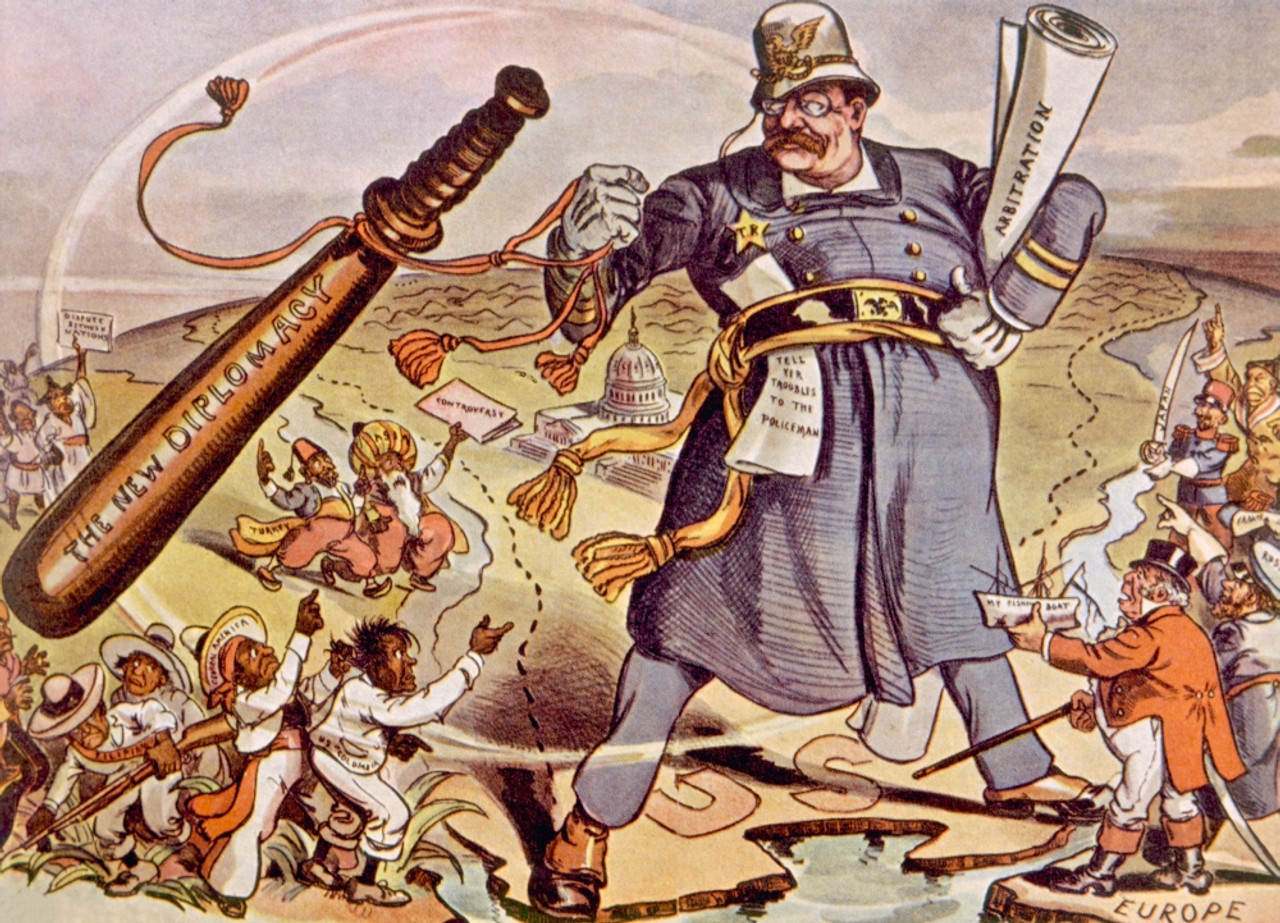
A war between two civilized nations, however, as between Germany and England, would be wasteful and foolish. Above all, Roosevelt believed in the balance of power. Strong, advanced nations like the United States had a duty to use their power to preserve order and peace. The United States had "no choice," Roosevelt said, but to "play a great part in the world." Americans could no longer "avoid responsibilities" that followed from "the fact that on the east and west we look across the waters at Europe and Asia." The 1900 census showed that the United States, with 75 million people, was much more populous than Great Britain, France, or Germany. These nations had many colonies in Asia and Africa, so it seemed time for Americans to exercise a greater role in world affairs.
As Roosevelt looked across the oceans, he developed a highly personal style of diplomacy. Bypassing the Department of State, he preferred face-to-face contact and personal exchange of letters with foreign ambassadors, ministers, and heads of state. Roosevelt made foreign policy while horseback riding with the German ambassador and while discussing history with the ambassador from France. A British emissary observed that Roosevelt had a "powerful personality" and a commanding knowledge of the world. As a result, ministries from London to Tokyo respected both the president and the power of the United States.
When threats of force failed to accomplish his goals, Roosevelt used direct personal intervention. "In a crisis the duty of a leader is to lead," he said. Congress was too slow and deliberate to play a significant role in foreign affairs. When he wanted Panama, Roosevelt bragged later, "I took the Canal Zone" rather than submitting a long "dignified State Paper" for congressional debate. And while Congress debated his actions, he was fond of pointing out, the building of the canal began. Roosevelt's energetic executive activism in foreign policy set a pattern for nearly every twentieth-century American president.
Taking the Panama Canal#


In 1906, 2,600 American troops were sent into Honduras and Nicaragua. Philander Knox, secretary of state from 1909 to 1913, justified these interventions: "We are in the eyes of the world, and because of the Monroe Doctrine, held responsible for the order of Central America, and its proximity to the Canal makes the preservation of peace in that neighborhood particularly necessary." The Panama Canal was not yet finished when Knox spoke, but it had already become a cornerstone of U.S. policy in the region. Three problems had to be surmounted to dig an interoceanic connection. First, an 1850 treaty bound the United States to build a canal jointly with Great Britain. But in 1901, John Hay, secretary of state between 1901 and 1905, convinced the British to cancel the treaty in exchange for an American guarantee that the canal would be "free and open to the vessels of commerce and of war of all nations." A second problem was where to dig it. American engineers rejected a long route through Nicaragua in favor of a shorter, more rugged path across the isthmus of Panama, where a French firm, the New Panama Company, had already begun work.
The third problem was that Panama was a province of Colombia and thus could not negotiate with the United States. The Colombian government was unimpressed with the share of a likely settlement the Americans would provide in buying up the New Panama Canal Company's $40 million in assets. Indeed, in 1903, the Colombian senate rejected a treaty negotiated by Hay, but mostly on nationalistic, not financial, grounds. Roosevelt, angered by this rebuff, called the Colombians "Dagoes" and "foolish and homicidal corruptionists" who tried to "hold us up" like highway robbers.
Aware of Roosevelt's fury, encouraged by hints of American support, and eager for the economic benefits the building of a canal would bring, Panamanian nationalists in 1903 staged a revolution led by several rich families and a Frenchman, Philippe Bunau-Varilla of the New Panama Canal Company. The Colombian army dispatched to quell the revolt was deterred by the presence of an American warship; local troops were separated from their officers, who were bought off. A bloodless revolution occurred on November 3; the next day, Panama declared its independence, and on November 6 the United States recognized the new government. Although Roosevelt did not formally encourage the revolution, it would not have occurred without American money and support.
On November 18, Hay and Bunau-Varilla signed a treaty establishing the American right to build and operate a canal through Panama and to exercise "titular sovereignty" over the ten-mile-wide Canal Zone. The Panamanian government protested the treaty, to no avail, and a later government called it the "treaty that no Panamanian signed." Roosevelt, in his later boast that he "took the canal," claimed that his diplomatic and engineering achievement, completed in 1914, would "rank ... with the Louisiana Purchase and the acquisition of Texas." Panama did not gain control of the canal until January 1, 2000.
Policeman of the Caribbean#
As late as 1901, the Monroe Doctrine was still regarded, according to Roosevelt, as the "equivalent to an open door in South America." To the United States, this meant that although no nation had a right "to get territorial possessions," all nations had equal commercial rights in the Western Hemisphere south of the Rio Grande. But as American investments poured into Central America and the Caribbean, the policy changed to one asserting U.S. dominance in the Caribbean basin.
This change was demonstrated in 1902, when Germany and Great Britain seized several Venezuelan gunboats and blockaded Venezuela's ports to force the government to pay defaulted debts. Roosevelt was especially worried that German influence would replace the British. He insisted that the European powers accept arbitration of the disputed financial claims and threatened to "move Dewey's ships" to the Venezuelan coast to enforce his intentions. The crisis passed, largely for other reasons, but Roosevelt's threat of force made very clear the paramount presence and self-interest of the United States in the Caribbean.
After the Spanish were expelled from Cuba, the United States supervised the island under Military Governor General Leonard Wood until 1902, when the Cubans elected their own congress and president. The United States honored Cuban independence, as it had promised to do in the Teller Amendment. But through the Platt Amendment, which Cubans reluctantly were forced to attach to their constitution in 1902, the United States obtained many economic rights in Cuba, a naval base at Guantanamo Bay, and the right to intervene if Cuban sovereignty were ever threatened. Newspapers in Havana assailed this violation of their newfound independence. One cartoon, titled "The Cuban Calvary," showed a figure representing the "Cuban people" crucified between two thieves, Wood and McKinley.
American policy intended to make Cuba a model of how a newly independent nation could achieve orderly self-government with only minimal guidance. Cuban self-government, however, was shaky. When in 1906 an internal political crisis threatened to plunge the infant nation into civil war, Roosevelt expressed his fury with "tlrnt infernal little Cuban republic." At Cuba's request, he sent warships to patrol the coastline and special commissioners and troops "to restore order and peace and public confidence." As he left office in 1909, Roosevelt proudly proclaimed that "we have done our best to put Cuba on the road to stable and orderly government." The road was paved with sugar. U.S. trade with Cuba increased from $27 million in the year before 1898 to an average of $43 million per year during the following decade. Along with economic development, American political and even military involvement in Cuban affairs continued throughout the century.
The pattern repeated throughout the Caribbean. The Dominican Republic, for example, suffered from unstable governments and great poverty. In 1904, as a revolt erupted, European creditors pressured the Dominican government for payment of $40 million in defaulted bonds. Sending its warships to discourage European intervention, the United States took over the collection of customs in the republic. Two years later, the United States intervened in Guatemala and Nicaragua, where American bankers controlled nearly 50 percent of all trade, the first of several twentiethcentury interventions in those countries.
Roosevelt clarified his policy that civilized nations should "insist on the proper policing of the world" in his annual message in 1904. The goal of the United States, he said, was to have "stable, orderly and prosperous neighbors." A country that paid its debts and kept order "need fear no interference from the United States." A country that did not, but rather committed "chronic wrong-doing" and loosened the "ties of civilized society," would require the United States to intervene as an "international police power." This doctrine became known as the Roosevelt Corollary to the Monroe Doctrine. Whereas Monroe's doctrine had warned European nations not to intervene in the Western Hemisphere, Roosevelt's corollary justified American intervention. Starting with a desire to protect property, loans, and investments, the United States wound up supporting the brutal regimes of elites who owned most of the land, suppressed the poor, blocked reform, and acted as American surrogates.
After 1904, the Roosevelt Corollary was invoked in several Caribbean countries. Intervention usually required the landing of U.S. Marines to counter a threat to American property. Occupying the capital and major seaports, marines, bankers, and customs officials usually remained for several years, until they were satisfied that stabijjty had been reestablished. Roosevelt's successors, William Howard Taft and Woodrow Wilson, pursued the same interventionist policy. So would later presidents, most recently Ronald Reagan (Grenada and Nicaragua), George Bush (Panama), and Bill Clinton (Haiti).
Recovering the Past - Political Cartoons#
One of the most enjoyable ways of recovering the values and attitudes of the past is through political cartoons. Ralph Waldo Emerson once said, "Caricatures are often the truest history of the times." A deft drawing of a popular or unpopular politician can freeze ideas and events in time, conveying more effectively than columns of type the central issues of the day and creating an immediate response in the viewer. It is this freshness that makes caricatures such a valuable source when attempting to recover the past. Cartoonists are often at their best when they are critical, exaggerating a physical feature of a political figure or capturing public sentiment against the government.
The history of political cartoons in the United States goes back to Benjamin Franklin's "Join or Die" cartoon calling for colonial cooperation against the French in 1754. But political cartoons were rare until Andrew Jackson's presidency. Even after such cartoons as "King Andrew the First" in the 1830s, they did not gain notoriety until the advent of Thomas Nast's cartoons in Harper's Weekly in the 1870s. Nast drew scathing cartoons exposing the corruption of William "Boss" Tweed's Tammany Hall, depicting Tweed and his men as vultures and smiling deceivers. "Stop them damn pictures," Tweed ordered. "I don't care so much what the papers write about me. My constituents can't read. But, damn it, they can see pictures." Tweed sent some of his men to Nast with an offer of $100,000 to "study art" in Europe. The $5000-a-year artist negotiated up to a half million dollars before refusing Tweed's offer. "I made up my mind not long ago to put some of those fellows behind bars," Nast said, "and I'm going to put them there." His cartoons helped drive Tweed out of office.
The emergence of the United States as a world power and the rise of Theodore Roosevelt gave cartoonists plenty to draw about. An impetus to political cartoons was given by the rise of cheap newspapers such as William Randolph Hearst's Journal and Joseph Pulitzer's World. When the Spanish-American War broke out, newspapers whipped up public sentiment by having artists draw pictures of Spaniards stripping American women at sea and encouraging cartoonists to depict the "Spanish brute." Hearst used these tactics to increase his paper's daily circulation to one million copies. But by the time of the Philippines debates, many cartoonists took an anti-imperialist stance, pointing out American hypocrisy. Within a year, cartoonists shifted from depicting "The Spanish Brute Adds Mutilation to Murder" (1898) to "Liberty Halts American Butchery in the Philippines" (1899). The cartoons are very similar in condemning "butchery" of native populations, but the target has of course changed. Although Uncle Sam as a killer is not nearly as menacing as the figure of Spain as an ugly gorilla, both cartoons share a similarity of stance, the blood-covered swords, and a trail of bodies behind.

When Theodore Roosevelt rose to the presidency, cartoonists rejoiced. His physical appearance and personality made him instantly recognizable, a key factor in the success of a political cartoon. His broad grin, eyeglasses, and walrus mustache were the kind of features that fueled the cartoonist's imagination. A man of great energy, Roosevelt's style was as distinctive as his look.

Other factors, such as the "Rough Rider" nickname, the symbol of the "big stick," and policies like "gunboat diplomacy" made Teddy the perfect target for political cartoons. To understand and appreciate the meaning of any cartoon, certain facts must be ascertained, such as the date, artist, and source of the cartoon; the particular historical characters, events, and context depicted in it; the significance of the caption; and the master symbols employed by the cartoonist. The two remaining cartoons, "Panama or Bust" (1903) and "For President!" (1904), were both printed in American daily newspapers. Aside from the context and meaning of each cartoon, which should be obvious, note how the cartoonists use familiar symbols from Roosevelt's life and American history to underline the ironic power of their point. How many can you identify, and how are they used?


Opening the Door to China#
Throughout the nineteenth century, American relations with China were restricted to a small but profitable trade. The British, in competition with France, Germany, and Russia, took advantage of the crumbling Manchu dynasty to force treaties on China creating "treaty ports" and granting exclusive trading privileges in various parts of the country. After 1898, Americans with dreams of exploiting the seemingly unlimited markets of China wanted to join the competition and enlarge their share. Moral interests, however, including many missionaries, reminded Americans of their revolutionary tradition against European imperialism. They made clear their opposition to crass U.S. commercial exploitation of a weak nation and supported the preservation of China's political integrity as the other imperial powers partitioned the country.

American attitudes toward the Chinese people reflected this confusion of motives. Some Americans held an idealized view of China as the center of Eastern wisdom and saw a "special relationship" between the two nations. But the dominant American attitude viewed the Chinese as heathen, exotic, backward, and immoral. The Exclusion Act of 1882 and the riots in western states against Chinese workers in the 1870s and 1880s reflected this negative stereotype. The Chinese, in turn, regarded the United States with a mixture of admiration, cuxiosity, resentment, suspicion, and disdain.
The annexation of Hawaii, Samoa, and the Philippines in 1898-1899 convinced Secretary of State Hay that the United States should announce its own policy for China. He did so in the Open Door notes of 1899-1900, which became the cornerstone of U.S. policy in Asia for half a century. The first note demanded an open door for American trade by declaring the principle of equal access to commercial rights in China by all nations. The second note, addressing Russian movement into Manchuria, called on all countries to respect the "territorial and administrative integrity" of China. This second principle opened the way for a larger American role in Asia, offering China protection from foreign invasions and preserving an East Asian balance of power.
An early test of this new role came during the Boxer Rebellion in 1900. The Boxers were a society ofyow1g traditionalist Chinese in revolt against both the Manchu dynasty and the growing Western presence and influence in China. During the summer of 1900, Boxers killed some 242 missionaries and other foreigners and besieged the western quarter of Peking. Eventually, an international military force of 19,000 troops, including some 3,000 Americans sent from the Philippines, marched on Peking to end the siege.
The relationship with China was plagued by America's exclusionist immigration policy. Despite the barriers and riots, Chinese workers kept coming to the United States, entering illegally through Mexico and British Columbia. ln 1905, Chinese nationalists at home boycotted American goods and called for a change in immigration policy. Roosevelt, contemptuous of the Chinese as a "backward" people, bristled with resentment and sent troops to the Philippines as a threat. Halfheartedly, he also asked Congress for a modified immigration bill, but nothing came of it.
Despite exclusion and insults, the idea that the United States had a unique guardian relationship with China persisted well into the twentieth century. Japan had ambitions in China, so this created a rivalry between Japan and the United States, testing the American commitment to preserve the Open Door in China and the balance of power in Asia. Economic motives, however, proved to be less significant. Investments there developed very slowly, as did the dream of the "great China market" for American grains and textiles. Although textile exports to China increased from $7 to nearly $24 million in a decade, the China trade always remained larger in imagination than in reality.
Japan and the Balance of Power#
Population pressures, war, and a quest for economic opportunities caused Japanese immigration to the United States to increase dramatically around the turn of the century. Coming first as unmarried males working on western railroads and in West Coast canneries, mjnes, and logging camps, immigrants from Japan increased from 25,000 in the 1890s to 125,000 between 1901 and 1908. Like the earlier Chinese immigrants, they met nativist hostility and discrimination. Japanese workers were barred from factory jobs and shunted off to agricultural labor in California fields and orchards. Many Japanese immigrants, however, became successful independent farmers despite the prejudice against them. In 1906, the San Francisco school board, claiming that Japanese children were "crowding the whites out of the schools," segregated them into separate schools and asked Roosevelt to persuade Japan to stop the emigration of its people. The insulted Japanese agreed to limit the migration of unskilled workers to the United States in a "gentleman's agreement" signed in 1907. In return, the segregation law was repealed, but not without costs in relations between the two nations.
Roosevelt worked hard to maintain the balance of power in East Asia. The Boxer Rebellion of 1900 left Russia with 50,000 troops in Manchuria, miling it the strongest regional power. Roosevelt's admiration for the Japanese as a "fighting" people and valuable factor in the "civilization of the future" contrasted with his low respect for the Russians, whom he described as "corrupt," "treacherous," and "incompetent." As Japan moved into Korea, and Russia into Manchuria, Roosevelt hoped that each would check the growing power of the other.

Roosevelt welcomed news in 1904 that Japan had successfully mounted a surprise attack on Port Arthur in Manchuria, beginning the Russo-Japanese War. He was "well pleased with the Japanese victory," he told his son, "for Japan is playing our game." But as Japanese victories continued, many Americans worried that Japan might play the game too well, shutting the United States out of Far Eastern markets. Roosevelt shifted his support toward Russia. When the Japanese expressed interest in an end to the war, the American president was pleased to exert his influence.
Roosevelt's goal was to achieve peace and leave a balanced situation. "It is best," he wrote, that Russia be left "face to face with Japan so that each may have a moderative action on the other." The negotiations and resulting treaty were carried out in the summer of 1905 near Portsmouth, New Hampshire. Nothing better symbolized the new American power and presence in the world than the signing of a peace treaty ending a war in Manchuria between Russia and Japan halfway around the globe in New Hampshire!
The Treaty of Portsmouth left Japan dominant in Manchuria and established the United States as the major balance to Japan's power. Almost immediately, the Japanese developed a naval base at Port Arthur, built railroads, and sought exclusive rights of investment and control in the Chinese province. In part because of his lack of respect for the Chinese, Roosevelt willingly recognized Japan's "dominance in Manchuria," as well as its control in Korea. But in return, in the Root-TakahiraAgreement of 1908, he got Japan's promise to honor U.S. control in the Philippines and to make no further encroachments into China.
These agreements over territorial divisions barely covered up the tensions in Japanese-American relations. Some Japanese were angry that they had not received in the Portsmouth Treaty the indemnities they had wanted from Russia, and they blamed Roosevelt. American insensitivity on the immigration issue also left bad feelings. In Manchuria, U.S. Consul General Willard Straight aggressively pushed an anti-Japanese program of financing capital investment projects in banking and railroads. This policy, later known as "dollar diplomacy" under Roosevelt's successor, William Howard Taft, like the pursuit of markets, was larger in prospect than results. Nevertheless, the United States was in Japan's way, and rumors of war circulated.
It was clearly a moment for Roosevelt's "big stick." In 1907, he told Secretary of State Root that he was "more concerned over the Japanese situation than almost any other. Thank Heaven we have the navy in good shape." Although the naval buildup had begun over a decade earlier, under Roosevelt, the U.S. Navy had developed into a formidable force. From 1900 to 1905, outlays to the Navy rose from $56 to $117 million. Such a naval spending binge was without precedent in peacetime. In 1907, to make it clear that "the Pacific was as much our home waters as the Atlantic," Roosevelt sent his new, modernized "Great White Fleet" on a goodwill world tour. The first stop was the Japanese port of Yokohama. Although American sailors were greeted warmly, the act may have stimulated navalism in Japan, which came back to haunt the United States in 1941. But for the time being, the balance of power in Asia was preserved.

Preventing War in Europe#
The United States was willing to stretch the meaning of the Monroe Doctrine to justify sending Marines and engineers to Latin America and the Navy and dollars to Asia. Treaties, agreements, and the protection of territories and interests entangled the United States with foreign nations from Panama and the Dominican Republic to the Philippines and Manchuria. Toward Europe, however, the traditional policies of neutrality continued.
Roosevelt believed that the most serious threats to world peace and civilized order lay in the relationships among Germany, Great Britain, and France. He established two fundamental policies toward Europe that would define the U.S. role throughout the century. The first was to make friendship with Great Britain the cornerstone of U.S. policy. As Roosevelt told King Edward Vll in 1905, "In the long run the English people are more apt to be friendly to us than any other." Second, the crucial goal of a neutral power like the United States was to prevent a general war in Europe among strong nations. Toward this end, Roosevelt depended on his personal negotiating skills and began the twentieth- century practice of summit diplomacy.
It is difficult now to think of England as anything other than the most Joyal friend of the United States outside North America. Yet throughout most of the nineteenth century, England was America's chief enemy and commercial rival. From the War of 1812 to the Venezuelan border crisis of 1895, conflict with Great Britain developed in squabbles over old debts and trade barriers, disputes over Canadian borders and fishing jurisdictions, and British interference in the American Civil War.
The Venezuelan crisis and a number of other events at the turn of the century shocked the United States and England into an awareness of their mutual interests. Both nations appreciated the neutrality of the other in their respective wars shouldering the white man's burden against the Filipinos and the Boers. Roosevelt supported British imperialism because he believed that England was "fighting the battle of civilization." Furthermore, both nations worried about growing German power in Europe, Africa, and the Far East. As German naval power increased, England had to bring its fleet closer to home. Friendly allies were needed to police parts of the world formerly patrolled by the British navy. England therefore concluded a mutual-protection treaty with Japan in 1902 and willingly let the Americans police Central America and the Caribbean Sea.
Similarities of language and cultural traditions, as well as strategic self-interest, drew the two countries together. Roosevelt's personal style furthered the connection. He was clearly and unashamedly pro-British, and his most intimate circle of friends included many Englishmen. Although Roosevelt sometimes criticized English policies, his British bias was never in doubt. He knew, as he wrote to Lodge in 1901, that the United States had "not the least particle of danger to fear" from England and that German ambitions and militarism represented the major threat to peace in Europe. As Roosevelt left the presidency in 1909, one of his final acts was to proclaim the special American friendship with Great Britain.

German Kaiser Wilhelm II often underestimated the solidity of Anglo-American friendship and thought that Roosevelt was really pro-German, an illusion the American president skillfully cultivated. Wilhelm, therefore, sought Roosevelt's support on several diplomatic issues between 1905 and 1909. In each case, Roosevelt flattered the Kaiser while politely rejecting his overtures. The relationship gave Roosevelt a unique advantage in influencing affairs in Europe to prevent the outbreak of war.
The Moroccan crisis in 1905 and 1906 is ilustrative. European powers competed for colonies and spheres of influence in Africa as well as in Asia. Germany in particular resented French dominance along the North African coast in Morocco and feared the recent AngloFrench entente. The Kaiser precipitated a crisis in the summer of 1905 by delivering a bellicose speech in Casablanca, intended to split the British and French and to force an opening of commercial doors in Morocco. In this endeavor, he sought help from Roosevelt. The French were outraged at Wilhelm's boldness, and war threatened. Roosevelt intervened, arranging a conference in Algeciras, Spain, to head off the conflict. The treaty signed in 1906 peacefully settled the Moroccan issue favorably for the French.
Roosevelt's successful countering of meddlesome German policies continued, as did his efforts in preventing war. At the Hague conference on disarmament in 1907, the Kaiser sought an agreement to reduce British naval supremacy, a superiority Roosevelt thought "quite proper." The German emperor also tried to promote German-Chinese-American entente to balance the Anglo-Japanese Treaty in Asia. Roosevelt rebuffed all these efforts. While on a European tour in 1910, the retired American president was warmly entertained and celebrated by Wtlhelm, who continued to misunderstand him. Roosevelt, meanwhile, kept on urging his English friends to counter the German naval buildup to maintain peace in Europe.
In 1911, Roosevelt wrote that there would be nothing worse than that "Germany should ever overthrow England and establish the supremacy in Europe she aims at." A German attempt "to try her hand in America," he thought, would surely follow. To avert it, Roosevelt's policy for Europe included cementing friendship with England and, while maintaining official neutrality, using diplomacy to prevent hostilities among European powers. The relationship between Great Britain and Germany continued to deteriorate, however, and by 1914, a new American president, Woodrow Wilson, would face the terrible reality that Roosevelt had skillfully sought to prevent. When World War I finally broke out, no American was more eager to fight on the British side against the Germans than the leader of the Rough Riders.